Phonemos. Structured teamwork for demanding environments.
The Problem
Most organisations run four or more separate tools where one would do.
A wiki for documentation. A dedicated GRC or QMS tool for governance and compliance. A project tracker for delivery work. A service desk for requests. Each carries its own licence, its own integration to maintain, and its own knowledge silo. External partners, customers, and auditors are either excluded entirely or given second-class access at extra cost. Information exchanged in low-level communication tools — email, chat, meetings — is ephemeral, hard to find, and impossible to govern.
Regulated environments face additional pressure: cloud-only or sunsetting on-premise products no longer match where data may legally live, and AI adoption creates a new category of sovereignty risk when a US hyperscaler processes sensitive knowledge.
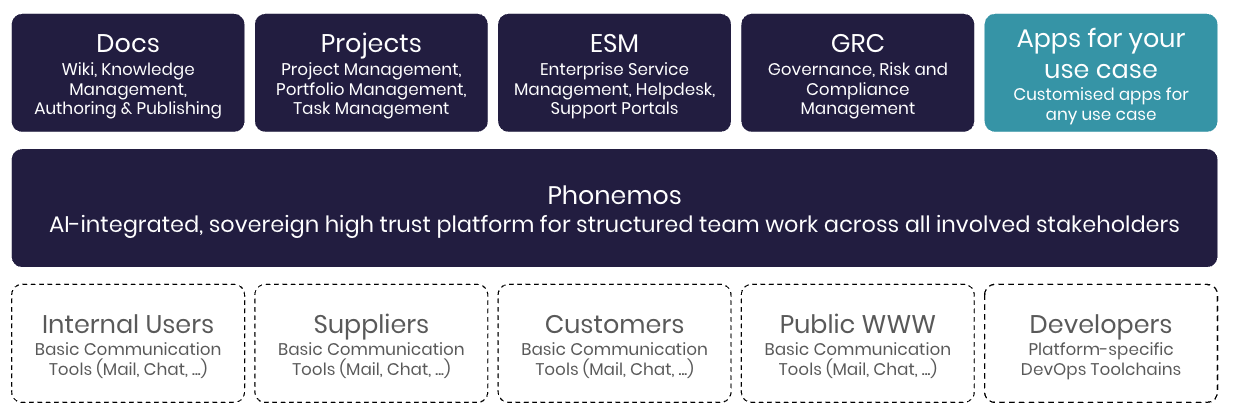
Real initiatives rarely look like “everyone is a developer.” Developers rightly use a platform-specific DevOps stack — repositories, pull requests, CI/CD, tests — tuned to their stack. They are often only a small share of participants. Product owners, project leads, business analysts, quality leads, and method specialists typically outnumber them, and large stakeholder communities need clear status and portals without a developer-tool licence. Those groups need one work-and-knowledge layer that is easy to adopt and scales economically, while engineering keeps the toolchain that fits the code.
What Phonemos Is
Phonemos is the sovereign, AI-integrated platform for structured, high-trust teamwork — replacing fragmented tool stacks with one platform for documentation, governance, projects, and enterprise services.
Four primary use cases share one data model, one access control system, and one AI layer. Not separate products. Not separately licensed.
Pillar | What it covers |
|---|---|
Phonemos Docs | Wiki, knowledge management, structured authoring and publishing, document governance. Multilingual, AI-powered semantic search, automatic translation via DeepL, public portals. |
Phonemos Projects | Project management, portfolio management, and task tracking. Kanban boards, Gantt charts, timelines, and risk matrices, embedded alongside the knowledge and governance layer. Connects to platform-specific DevOps stacks via integrations. |
Phonemos GRC | Governance, risk and compliance: management systems (ISO 9001, 14001, 27001 and others), process documentation, risk registers, audit trails, compliance workflows, KPIs and objectives. Proven in production — linkyard runs its own certifications on Phonemos. |
Phonemos ESM | Structured service delivery, helpdesk, request management, and service catalogues. Applicable to any internal or cross-org service function, not only IT. |
Three Commitments
Three principles run through the product and show up across all four pillars:
Foster participation. Make contributing straightforward. Collaboration should not be a bureaucratic obstacle course. Give teams the tools to participate as directly as possible while respecting rules and regulations. Phonemos includes a viewer licence for participants who need to read and comment but not edit — so the platform scales to large stakeholder communities without unnecessary cost.
Border-free collaboration. Work across organisations, languages, and device types without friction. External users — partners, customers, auditors, suppliers — can participate without full licences or being forced into your identity infrastructure. Multilingual content with automatic DeepL translation is built in, not bolted on.
Digital and data sovereignty. Keep data where regulation and policy allow. No US cloud providers in the stack — US CLOUD Act not applicable. ISO 27001:2022 certified. GDPR-compliant under Switzerland’s EU adequacy decision. Deploy in the Swiss cloud, any AWS region, or on-premise. Bring your own LLM for AI without compromising sovereign control.
AI Integration
Phonemos does not lock you into one AI provider. Three capabilities are live today:
AI-powered semantic search — find content by meaning across wiki pages, Word and PDF files, and OCR-extracted image text.
MCP server — exposes the Phonemos knowledge base to external AI agents and enterprise LLM platforms as grounded context.
Bring your own LLM — connect any OpenAI-compatible endpoint (Copilot, Mistral, local on-premise, or other). Per-site opt-in keeps sensitive content LLM-free.
An embedded AI agent is in development. One AI security assessment covers all four use cases.
Phonemos in Context
Buyers often compare Phonemos with knowledge suites and wikis, with work-management and issue-tracking tools, with dedicated GRC/QMS tools, and with developer-centric DevOps platforms. Those categories optimise different centres of gravity. Phonemos is built so business users and stakeholders can work across all four use cases in one model, while connecting to — not replacing — the platform-specific DevOps stack that engineers use day to day.
The DevOps positioning is deliberate: a platform-specific DevOps stack is the right tool for engineering workflows. It is not the right tool for the project managers, business analysts, quality leads, and stakeholders who make up the large majority of project participants. Phonemos serves that majority, and connects to the engineering layer via integrations.
Swiss-Made: What It Means
Phonemos is developed and operated by linkyard AG, headquartered in Bern, Switzerland. This has concrete implications:
Data residency. By default, all data is stored in Switzerland. Phonemos also supports hosting on any AWS region or fully on-premise.
Legal jurisdiction. Swiss data protection law (nDSG) is among the strictest in the world and is recognised as adequate by the European Union. The US CLOUD Act does not apply because no US-based companies are involved in the stack.
Certifications. The platform is certified under ISO/IEC 27001:2022 (information security), ISO/IEC 14001:2015 (environmental management), and ISO/IEC 9001:2015 (quality management). All three certifications are maintained on Phonemos itself — the GRC platform is proven in the environment that governs its own operations.
No vendor lock-in. Phonemos supports open standards for import and export (Markdown, PDF, Word, LaTeX, ODF, JSON). Migration tooling is available for Confluence, SharePoint, Azure DevOps Wiki, Word, MediaWiki, and DokuWiki.
For organisations in regulated industries — finance, healthcare, government, critical infrastructure — these properties are requirements, not nice-to-haves.